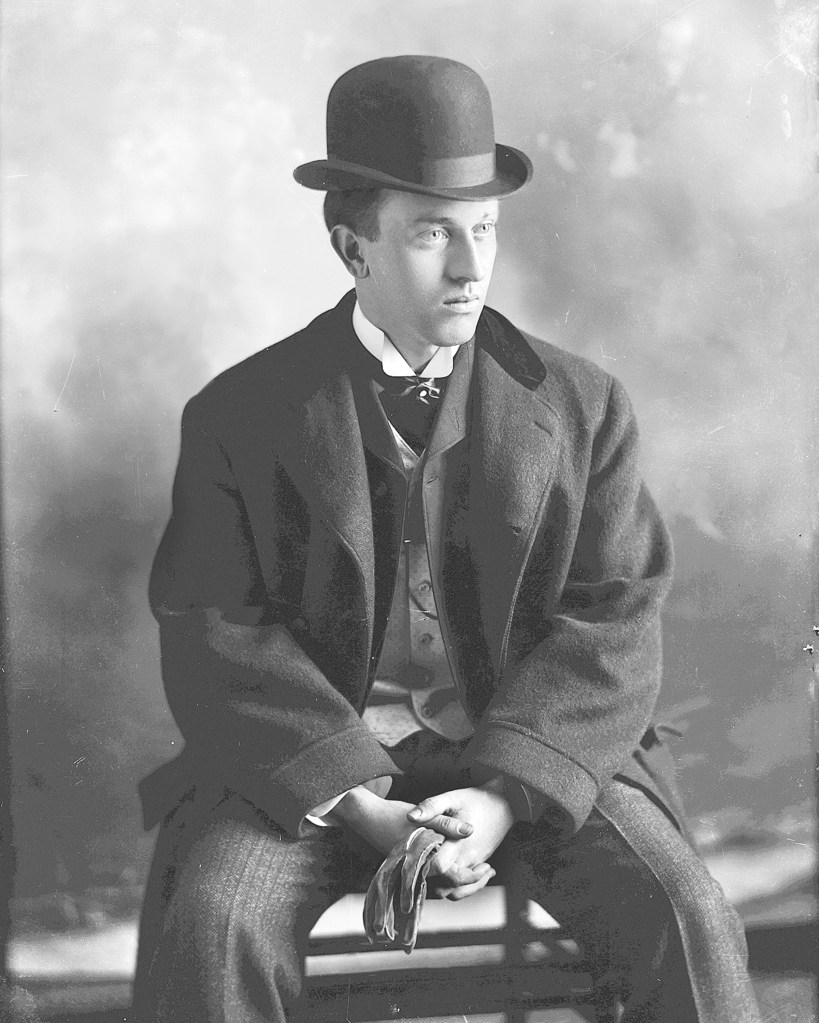
On a farm near where the current day Buffalo Trace Distillery is located in Frankfort, Kentucky, Colonel Albert Bacon Blanton was born on Monday February 28, 1881 to Benjamin Harrison Blanton and Alice Elizabeth Blanton. Albert’s father was born on Wednesday December 16, 1829 and his mother on Tuesday July 25, 1843. Albert was the youngest of four children his parents had. His siblings included James Bacon Blanton (1869-1952), Elizabeth Dudley Blanton (1871-1952) and Benjamin Harrison Blanton, Jr. (1875-1939). Albert grew up smelling and seeing the activities of distillation at the Old Fire Copper Distillery that was near his home where he was born and raised. Little did he know that he would end up becoming such an intricate part of the distillery and part of its rich history.
Albert joined the Old Fire Copper Distillery, commonly referred to as O.F.C., in 1897 at the age of 16. He was hired on as an office boy. The O.F.C. Distillery got its start in 1869 when Edmund Haynes Taylor Jr. purchased a distillery in Leestown, a settlement near the east side of the Kentucky River which is the modern day Frankfort, from the Swigert family and renamed it. The original distillery was torn down in 1873 and rebuilt as a brand new facility. Edmund focused on making the distillery as great as he could by using copper fermentation tanks, updated grain equipment, column stills and even steam heating systems in warehouses to help regulate the temperatures for controlled aging of the whiskey. All of these improvements were great innovations at the time, but they also didn’t come cheaply. Most of the improvements to the distillery were made on credit and Edmund Jr. was having difficulties paying off his debt. Hardship found Taylor once again in 1879 when he was near becoming bankrupt, so his debts were purchased by a St. Louis liquor firm Gregory and Stagg. Since Taylor could not repay his debts, as payment he sold the Old Fire Copper distillery to the firm. The new owners of the O.F.C. Distillery were made up of James Gregory and the legendary George Thomas Stagg. In 1882 hardship hit the distillery when lightning struck the plant causing a fire that destroyed it. By 1883 the distillery was rebuilt and the same building is still in existence today. In 1904 the distillery was renamed the George T. Stagg Distillery.
Albert began working his way through the distillery learning the various aspects of its operations and eventually worked his way to being promoted to plant manager in 1912. Saturday January 17, 1920 marked the beginning of the nationwide Prohibition of alcohol production in the United States. Only six distilleries were allowed to produce alcohol for medicinal purposes this time under a special license from the government, and the George T. Stagg Distillery was not one of them. Prohibition brought the end to many distilleries and brands due to not being able to sell their products or produce during this time. Albert was able to help the distillery get through these troubling times by applying for one of the four licenses granted by the government to be a bottling facility and bottle medicinal spirits. This directly helped the distillery to survive throughout Prohibition. Without him the story of this iconic distillery could have been lost to history.
In 1921 Albert became the president of the George T. Stagg Distillery. Distillery ownership change came in 1929 when Shenley purchased the George T. Stagg Distillery. Shenley was one of the only few distilleries with a license to produce during Prohibition, so after the purchase the George T. Stagg Distillery was able to begin production once more under the license of its new owner. Albert retained his position as president even after the ownership change. Prohibition ended on Tuesday December 5, 1933 but more hardships were around the corner. In 1937 a great flood struck the distillery causing property and equipment to be underwater and damaged. Albert is credited with working endlessly until he had the plant back up and running and was able to do so in twenty-four hours.
Much of what you see today at the distillery is because of the actions of Albert Blanton. He greatly expanded the distillery during his time there, even helping to resist a shut down during World War II as the distillery had enough capacity to distill for the war efforts and its own distillation. During a time when most distilleries had an industrial look, Albert began to improve the aesthetic appearance of the distillery by adding gardens and even building a clubhouse. He spent much of his time dedicated to the distillery that even in his off time he was not far away. He had his home built on the distillery property overlooking the distillery. His home was known as Stony Point.
As a person, Blanton was known as a modest man despite the great accomplishments that he achieved throughout his long career. He was bestowed the title Colonel from the Commonwealth of Kentucky for all of his accomplishments. This title is a different designation than being a Colonel of the army. Albert, being the humble man he was, often did not like to be called Colonel because so many others in the military had earned the title and he hadn’t. Whether he liked the title or not, he has gone down in history as Colonel Blanton.
In his personal life, Albert married Vannie Blanche Stevens on Wednesday January 31, 1934. Vannie was born on Tuesday August 14, 1894. Albert’s father Benjamin died on Sunday June 29, 1884 and was buried at the Frankfort Cemetery in Frankfort, Kentucky. Albert’s mother, Alice, died Sunday December 2, 1917 and was also buried at the Frankfort Cemetery. Colonel Blanton was also known to enjoy hosting parties and for his guests he would share with them some of his favorite bourbon from the distillery, especially from his personal favorite warehouse, Warehouse H. He thought that this warehouse produced the most exquisite bourbon for his tastes that he would pick barrels from this location to share with his guests. One of the perks of being the president of a large distillery is knowing where the best places to find the finest barrels were and for the Colonel that was in Warehouse H. Warehouse H is a metal warehouse built in 1935 that ages barrels of bourbon and the Colonel discovered that the makeup of the material allowed for the barrels to age the distillate differently due to how the temperature in the warehouse rises and falls.
After 55 years of dedication to the distillery, in 1952 the Colonel retired. On Thursday May 21, 1959 Albert Blanton died and was buried at the Frankfort Cemetery. Albert’s wife Vannie passed away nearly two decades after her husband on Wednesday January 5, 1977. Although the legend himself had died, his legacy was far from over. In 1984 Master Distiller Elmer Tandy Lee honored Blanton by curating the first commercial single barrel brand, Blanton’s Single Barrel. Elmer had worked under Colonel Blanton briefly after joining the distillery in September 1949 as a maintenance engineer until the Colonel’s retirement in 1952. Although the time working together was short, it was long enough to leave a lasting impression on Lee. When Elmer was originally looking for a job at the distillery he had asked Colonel Blanton for a job, however the Colonel had told him that they were not hiring at the moment. In the end, Elmer got a position at the company through other means.
The introduction of Blanton’s bourbon gave birth to a whole new category of the bourbon industry by commercially offering a single barrel option to consumers. The choice to make it a single barrel was a tribute to Albert’s picking of single barrels for his guests. To keep the tradition going, all Blanton’s Single Barrel barrels come from Warehouse H just like the Colonel liked. The same way that Albert Blanton enjoyed his bourbon is the same way that we get to enjoy it today each time we open up a bottle of Blanton’s. At the time that this premium product was introduced, bourbon was not seen as a classy product, but rather a value alcohol. Asking a higher price tag for a product in an industry where value pricing was seen as more important was an unwise idea to some, but Elmer’s idea would soon catch on and help change the pace of the bourbon industry as a whole.
Blanton’s is bottled in a grenade shaped packaging with a cork topper featuring a horse. While originally the toppers did not feature individually marked letters, in 1999 collectable engraved stoppers were introduced with each stopper featuring a single letter in which if all are collected spell out “BLANTON’S”. Each different stopper features a horse and jockey in a different stride representing the various stages of a horse race which is extremely popular and a rich part of Kentucky history. Blanton’s Original Single Barrel is bottled at 93 proof (46.5% alcohol by volume). The company offers many other variations of Blanton’s including Gold Edition bottled at 103 proof (51.5% alcohol by volume) which was introduced in the early 1990’s internationally, but wasn’t available in the United States until 2020. Straight from the Barrel features Blanton’s bourbon bottled at cask strength and each bottling can produce various proofs depending on the barrel. Special Reserve being bottled at 80 proof (40% alcohol by volume).
The distillery that Albert had put so many years of his life in was eventually sold to the Sazerac Company of New Orleans, Louisiana in 1992 and renamed the Buffalo Trace Distillery in 1999. At the historic distillery they still produce the namesake bourbon honoring him made in the same buildings Blanton once worked in and from the same warehouse he once walked. Colonel Blanton lived a life full of dedication to the distillery and left behind a legacy that has affected the entire bourbon industry as a whole. Even though the Colonel may be gone, his story lives on through the history of this legendary bourbon icon. The next time you are sipping Blanton’s Single Barrel you are drinking it the way that Blanton himself would have wanted the bourbon to be enjoyed and you are sipping more than what’s in your glass, you are sipping history.
For further reading we recommend checking out Warehouse H: The Story of Blanton’s Bourbon: America’s Most Influential Whiskey by Dominic Guglielmi. Click the link to take you directly to Amazon to purchase.
 Sipping History